본문
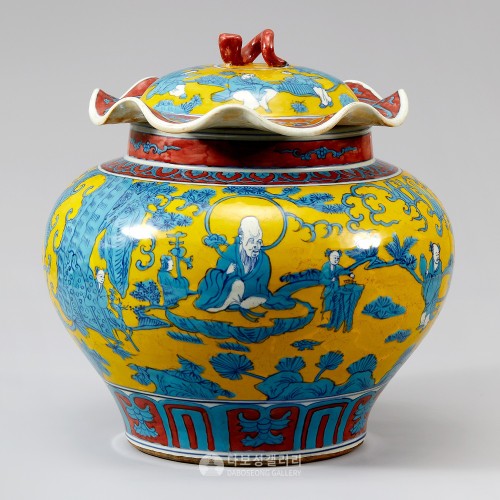
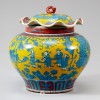
명나라 만력제 을묘년(1615년)에 제작된 오채 항아리입니다. 관지와 명문을 통해 봉헌 시기와 장소, 제작자 등이 구체적으로 확인되어 역사적 가치가 높은 유물로 사료됩니다.
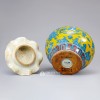
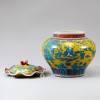
뚜껑은 연잎, 손잡이는 덩굴 형태입니다. 구연부와 굽이 넓고 몸통이 풍만하게 부푼 항아리입니다. 굽은 접지면이 넓고, 일부 유약을 바르지 않아 태토가 드러나며 모래 받침 흔적이 확인됩니다.
시문 기법은 명나라 만력 연간에 성행한 오채입니다. 청화로 윤곽을 그린 뒤 유약을 입혀 소성하고, 그 위에 적색·황색·청록색 안료를 덧입혀 다시 구워낸 유상채(釉上彩) 기법입니다. 각 색채는 길상, 권위, 생명력 등의 의미를 가집니다
뚜껑 테두리와 항아리 목 부분에는 적색 바탕에 청록색으로 당초문과 연화문을 교차 시문하였고, 동체 하단에는 변형된 연판문을 둘렀습니다.
뚜껑 상면과 동체에는 황색 바탕에 청록색으로 인물과 길상 소재를 시문하였습니다. 바위 위에 앉아 있는 수성신(壽星)을 중심으로 동자, 소나무, 사슴 등이 함께 배치되어 있습니다. 수성신은 도교의 복록수 삼성(福祿壽三星) 중 하나로, 장수를 상징하며 돌출된 이마가 특징입니다.
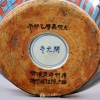
굽바닥에는 ‘大明萬曆乙卯年(대명만력 을묘년)’, ‘開元寺(개원사)’, ‘漳州府東溪鄕 治子陈福成叩謝(장주부동계향 치자 진복성 공사)’의 관지와 명문이 확인됩니다. 이는 명 만력 을묘년(1615년)에 장주부 동계향 출신의 장요(漳窯) 도자 장인 진복성이 제작하여 취안저우 개원사에 봉헌한 것임을 알 수 있습니다.
━━━━━
此五彩罐制作于明代万历乙卯年(1615年)。通过款识与铭文,可具体确认其奉献时期、地点及制作者,具有极高的历史价值。
盖作荷叶形,钮为藤蔓形。器物宽口,宽足,鼓腹。圈足局部施釉露胎,并可见垫砂烧造痕迹。
装饰技法为明代万历年间盛行之五彩。先以青花勾勒轮廓,施釉高温烧成后,再于釉面加绘红、黄、蓝绿色彩复烧而成,属釉上彩技法。各种色彩分别寓意吉祥、权威与生命力。
盖沿与罐颈部位,以红彩为地,其上施蓝绿色交替描绘缠枝纹与莲花纹;器身下部环饰变形莲瓣纹。
盖面与器身以黄彩为地,施蓝绿色描绘人物及吉祥题材。中央为坐于岩石上的寿星神,周围有童子、松树与鹿。寿星神为道教福禄寿三星之一,象征长寿,特征为额部隆起。
圈足底部可见“大明萬曆乙卯年”、“開元寺”、“漳州府東溪鄕 治子陈福成叩謝”等款识与铭文。据此可知,此器为明万历乙卯年(1615年),由漳州府东溪乡出身之漳窑陶工陈福成制作,并奉献于泉州开元寺。
━━━━━
This Wucai jar was produced in 1615, the yimao year of the Wanli reign during the Ming Dynasty. It is considered an artifact of immense historical significance, as its marks and inscriptions provide specific details regarding its date of production, origin, and the person who commissioned it.
The cover is fashioned in the form of a lotus leaf, topped with a vine-shaped knob. The jar itself features a wide rim and foot, with a bulbous, voluminous body. The base has a broad contact surface, partially unglazed to reveal the clay body, and bears distinct traces of sand-supported firing.
The decoration employs the Wucai technique, which reached its peak during the Wanli period. This overglaze enamel method involves drawing outlines in underglaze blue, glazing and firing the vessel, and then applying red, yellow, and turquoise enamels before a second firing. Each color carries symbolic meanings of auspiciousness, authority, and vitality.
The rim of the cover and the neck of the jar are decorated with alternating turquoise lotus and vine scrolls against a red ground, while the lower section of the body is encircled by a band of stylized lotus lappets.
The top of the cover and the main body feature figures and auspicious motifs in turquoise against a yellow ground. The central figure is Shouxing seated on a rock, surrounded by boys, pine trees, and deer. Shouxing, one of the Daoist Three Stars representing longevity, is identified by his characteristically prominent forehead.
The base of the jar bears the inscriptions: "Great Ming Wanli Yimao Year," "Kaiyuan Temple," and "Respectfully offered by Chen Fucheng, a devotee from Dongxi, Zhangzhou." These records confirm that the jar was crafted in 1615 by Ch
