본문
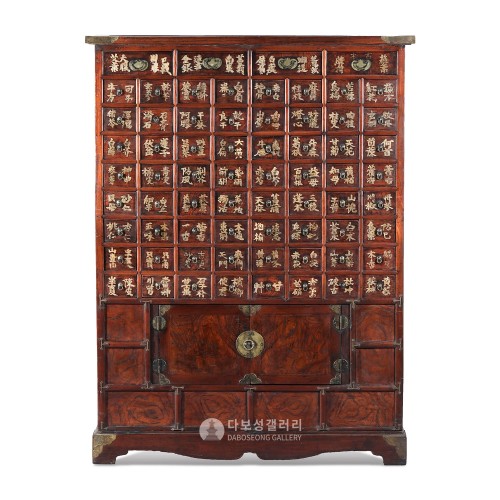
애엽 대복 | oo 파극 | 금은 oo | 남성 만형 | 서각 백질 | 선퇴 의이 | 박하 | 소엽 |
우방 가자 | 현삼 건o | 위령 속단 | oo 조각 | 지골 oo | 계피 마황 | 오매 고련 | 홍화 매목 |
저령 택사 | 활석 석고 | 아교 간잠 | 양간 oo | 산사 향부 | 등심 oo | 계피 육계 | 현호 목단 |
백소 백개 | 복분 연자 | oo oo | 백변 대황 | 우슬 귀판 | 갈근 승마 | 감국 천화 | 인진 하수 |
맥아 신곡 | 귤피 청피 | 방풍 형개 | 전호 시호 | 적작 백작 | 백부근 익모 | 지모 황백 | 곽향 곽향 |
패모 사인 | 세신 백지 | 익지 oo | 독홝 강활 | 천마 창포 | 봉출 삼릉 | 강황 산치 | 천초 단삼 |
도인 행인 | 오미 목과 | 정향 회향 | 차전 목통 | 지유 원지 | 토사 구기 | 삽주 백출 | 오약 방기 |
산사육 반하 | 지실 기각 | 사삼 길경 | 천문 맥문 | 황련 황령 | 적복 백복 | 산수 산약 | 목향 귀미 |
반하 진피 | 천궁 당귀 | 초과 후박 | 사군 빈랑 | 초 감 | 망초 향유 | 파고 두충 | 복신 황기 |
약장은 여러 한약재를 실용적으로 보관하기 위해 고안된 가구입니다. 약재를 종류별로 구분하여 넣을 수 있도록 많은 서랍이 있는 것이 특징으로, 적게는 20개에서 많게는 200개 정도까지 갖추었습니다. 많은 수의 약재를 보관하였기에 각 서랍마다 약재명의 표기는 필수적이었습니다.
상단에 활형 들쇠가 달린 서랍 4개가 있고 그 아래로 고리가 달린 서랍이 8개씩 8줄로, 총 68개의 서랍이 있습니다. 하단의 중앙에는 여닫이문이 달린 수납공간이 있으며, 내부에 넣고 뺄 수 있는 선반이 있어 공간을 다양하게 활용할 수 있는 구조입니다. 이곳에는 귀중한 약재나 독약을 보관한 것으로 알려져 있으며, 잠금장치를 통해 보관의 안전성을 높였습니다. 다리는 마대 형식으로 박쥐 형태의 풍혈(風穴)이 있습니다. 천판과 여닫이문, 마대의 모서리에는 화형(花形) 귀장석이 부착되어 있습니다. 단단한 목질과 뚜렷한 나뭇결을 가진 느티나무와 참죽나무, 방습 및 방충 기능이 있는 오동나무로 제작되었습니다.
조선시대에는 의원과 약재가 널리 보급되지는 못했기 때문에 약장은 관청이나 전문 의원, 혹은 양반가에 한정되어 발전하였고, 전통가구 중에서도 희소한 편에 속합니다. 귀한 약재를 안전하고 편리하게 보관하고자 했던 선조들의 삶과 지혜를 엿볼 수 있는 유물입니다.
━━━━━
药柜是为存放多种中药材而设计的家具。设有大量抽屉,可按药材种类分类存放,少则约20个、多则可达200个左右。因需要保存大量药材,所以在每个抽屉上标注药材名称。
药柜最上端设有4个带弓形提环的抽屉,其下方为8列、每列8个带拉环的抽屉,共计68个抽屉。下端中央设有带对开门的储物空间,内部配有可自由抽取和放置的隔板,可根据需要灵活利用空间。据称此处用于存放珍贵药材或毒药,并通过锁具提高保管的安全性。柜腿采用马蹄足形式,并饰有蝙蝠形风穴。顶板、柜门及马蹄足转角处均镶嵌花形角叶饰。药柜选用木质坚硬、纹理清晰的榉树和香椿木,以及具有防潮、防虫功能的泡桐木制作而成。
朝鲜时期,由于医者和药材尚未得到广泛普及,药柜的发展主要局限于官署、专业医馆以及两班贵族家庭,因此在传统家具中属于较为稀有的类型。此文物展现了古人为了安全、便利地保存珍贵药材所积累的生活经验与智慧。
A medicine cabinet is a piece of furniture designed for the practical storage of various traditional medicinal ingredients. Characterized by its numerous drawers for organizing medicinal materials by type, medicine cabinets typically range from around 20 to as many as 200 drawers. Because they were used to store a large number of medicinal ingredients, labeling each drawer with the name of its contents was essential.
This example consists of a total of 68 drawers, including four upper drawers fitted with bow-shaped drop handles and sixty-four drawers below arranged in eight rows of eight, each fitted with ring pulls. At the center of the lower section is a storage compartment with hinged doors, containing a removable shelf that allows for versatile use of the interior space. This compartment is known to have been used for storing valuable medicinal ingredients or toxic substances, with a locking mechanism enhancing storage safety. The medicine cabinet stands on madae-style legs, with a base distinct from the body, and features bat-shaped ventilation openings. Floral-shaped corner metal fittings are attached to the corners of the top panel, hinged doors, and the madae-style legs. It is made of zelkova and toon wood, valued for their hardness and distinct grain, as well as paulownia wood, known for its moisture-resistant and insect-repellent properties.
During the Joseon Dynasty, medical practitioners and medicinal ingredients were not widely accessible. As a result, medicine cabinets developed primarily within government offices, professional physicians’ practices, and noble households, making them relatively rare among traditional furniture. This artifact offers a glimpse into the lives and wisdom of ancestors who sought to store precious medicinal ingredients safely and conveniently.