본문
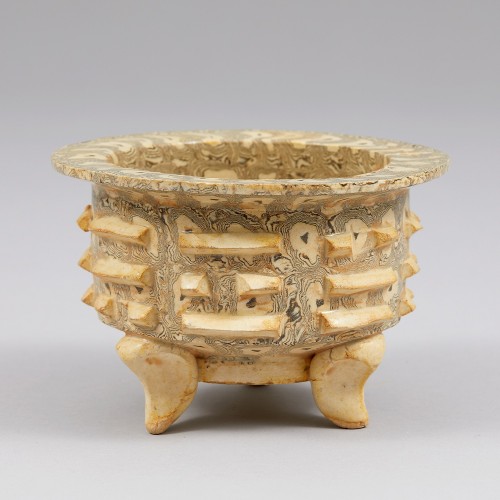
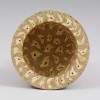
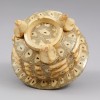
북송 시대 교태문(絞胎紋)의 대표 산지인 허난성 당양욱요(當陽峪窯)에서 제작된 것으로 추정되는 삼족 향로입니다. 고대 청동기인 '정(鼎)'의 형태와 유사합니다. 이는 옛것을 본받으려던 송대의 방고(倣古) 문화를 보여줍니다.
상단에는 넓게 벌어진 전이 있으며 몸체 하단에는 별도로 제작한 굽과 세 개의 다리를 부착하였습니다. 원통형 몸체 측면에는 팔괘(八卦) 형태의 융기문(隆起文)이 보입니다. 팔괘는 우주 만물의 질서와 변화를 상징합니다. 향을 통해 하늘과 소통하는 향로의 용도와 맞물려 벽사기복(辟邪祈福)의 의미를 더합니다.
유물의 전면에는 교태문이 나타납니다. 서로 다른 색의 흙을 겹겹이 쌓거나 꼬아 불규칙하고 자연스러운 형태를 이룹니다. 안팎과 바닥까지 문양과 질감이 동일하게 형성되는 것이 특징입니다. 그 위로 투명유를 시유하여 문양이 선명하게 드러납니다.
당대 시작된 교태문은 북송 시기 전성기를 맞았으나, 원나라 전란기를 거치며 제작 사례가 줄어들었습니다. 서로 다른 흙의 성질 차이로 인해 소성이 까다롭고 수율이 낮아, 오늘날 온전하게 전해지는 사례가 드문 희소한 유물입니다.
三足香炉推测产自北宋时期河南省当阳峪窑,是绞胎纹的代表性产地之一。其造型与古代青铜器“鼎”相似,体现了宋代崇尚仿古的文化风尚。
器物平折沿,圆筒腹,其下部另接底与三足。器身侧面呈八卦形隆起纹饰。八卦象征宇宙万物的秩序与变化,与通过焚香与天相通的香炉用途相结合,更添辟邪祈福寓意。
器表通体施绞胎纹装饰。该工艺通过将不同颜色的泥料层层叠加或相互绞合,形成自然流动、变化丰富的纹样,其纹理自内至外、由口及底浑然一体。其上施以透明釉,使纹样更加清晰可见。
绞胎工艺始于唐代,于北宋时期达到鼎盛,但在元代战乱之后逐渐减少。由于不同泥料物性差异较大,烧制难度高、成品率低,故完整保存至今的实物极为罕见。
This tripod incense burner is presumed to have been produced at the Dangyangyu kiln in Henan Province, a major production site for marbled (jiaotai) ware during the Northern Song Dynasty. Its form resembles the ancient bronze vessel known as "Ding," reflecting the archaising (fanggu) culture of the Song Dynasty that sought to emulate antiquity.
The upper section features a wide everted rim, while a separately crafted base and three feet are attached to the lower portion of the cylindrical body. The sides of the body are decorated with raised motifs in the form of the Eight Trigrams, which symbolize the fundamental order and constant changes of the universe. Given the incense burner's function as a medium for communicating with the heavens through incense, these motifs imbue the artifact with the symbolic intent of warding off evil spirits and invoking good fortune.
A marbled pattern appears across the entire surface of the artifact. This is formed by layering or twisting different colored clays into irregular and natural shapes. A characteristic feature of this technique is that the patterns and textures are formed consistently throughout the interior, exterior, and base. A transparent glaze was applied over the surface to clearly reveal the motifs.
Marbled ware, which originated in the Tang Dynasty, reached its peak during the Northern Song period but saw a decline in production following the conflicts of the Yuan Dynasty. Due to the difficulty of firing and low yields caused by the varying properties of the different clays, it is a rare artifact with few intact examples surviving today.